Things Fall Apart

Chinua Achebe
(Franklin)
Chinua Achebe is a famous writer who grew up and lived in Nigeria. Unlike his family, Achebe was heavily influenced and awed by the English language. His parents were converted to Christianity by missionaries while the rest of his family stuck to the traditional Igbo ways. Seeing first hand what conflicting morals presented, Achebe had a unique scenario in which he marveled at the possibilities. Learning English at age 8, he was accepted into a boarding school established by the colonizers. At this school, Chinua Achebe learned much about works written about Africa by Europeans. Most works of the time described Africans as being “savages” or “lost people.” Wanting to express how Africa was from an African’s perspective, Chinua set out to write his famous work titled “Things Fall Apart.” In this novel, the life of a young child is followed for years as the struggles of everyday life make an appearance. Achebe would eventually go on to write a trilogy based on this first work. At the time that TFA was published, only a few other works of its kind had been produced. Due to this, it was prone to failure. After publishing, Achebe received much criticism from Europeans claiming that his work was inaccurate. Achebe fought through these critical moments and eventually became a very famous author.
Did you know?
The British imperialized Africa because they claimed Africans were "uncivilized!"
Article Questions
King Leopold most likely referred to the word “civilization” as conquering. After all, his intentions were to create his own empire. The Scramble for Africa was centered around conquering the unknown places mentioned by Leopold. By using the word “civilization,” he hoped it would not sound as horrific, however, his true plans were to conquer. All in all, I do not believe that King Leopold meant what he said when he stated the word "civilization." Based on what events played out afterward, he most likely meant conquer
The Scramble for Africa is very similar to the colonization of the Americas. Much like in Africa, when Europe colonized the Americas, millions of natives were murdered in the process of satisfying the needs of the mother countries. In total, 90% of the native population in the Americas died due to European colonization. Furthermore, both instances called for Europeans to strip their colonies dry of all of the natural resources, leaving behind a place of despair. The two civilizations differ in the aftermath of their situations. While Africa remains in turmoil, the Americas built up strong nations, such as the United States or Canada. Because of this one difference, the Americas were able to recover from European destruction, while Africa still struggles to this day with the aftermath.
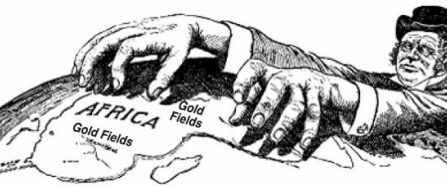

In my opinion, it is not fair for one country to come into another and take their resources in times of peace nor in times of war. In times of peace, countries are not at odds with each other and are trying to build up and maintain a strong nation. During these times, the country relies on their own resources in order to progress in the world. When another country decides to come and take what is not theirs, they are putting the country at risk of turmoil in a time that should have been peace. Furthermore, the action of taking resources from another country might provoke war. Like times of peace, times of war are excuses to take from others. Tensions are already high and taking is not going to help anybody’s situation. Additionally, by taking the other’s resources, one is weakening that country in a time when they need to be strong. All in all, it is not okay to take from others in times of war nor in times of peace.
Recently, I have begun watching “The Crown” on Netflix. “The Crown” is a show about the early life of Queen Elizabeth II and the hardships she had to face. One of these hardships included Egyptians rebelling against the British in order to regain control of the Suez Canal. This conflict could have been avoided if England had given Egypt total freedom after the Age of Imperialism. If freedom was obtained, then Egypt could have controlled the canal and conflict would not have broken out.

Opening Scene Analysis
TFA Stands for "Things Fall Apart"
In the opening scene of “Things Fall Apart,” Chinua Achebe opens with a description of Igbo culture that rivals the European views on Africa. In European views, Africans are seen as savages who have no culture, society, or morals. In actuality, cultures, such as the Igbo, thrive and prosper in these African nations. In describing the culture of the Igbo, the novel states “[...] the founder [...] engaged a spirit of the wild for seven days and seven nights” (Achebe 3). Christianity was the dominant religion of the British in the time period of the novel. In the Bible, there is a story of Jesus surviving forty days and forty nights in a desert. Much like in the Bible, the Igbo have a story of their founder surviving seven days and seven nights. By mentioning this detail on the first page of his novel, Achebe demonstrates that the fundamental reason for British colonization was wrong in the fact that Africans do indeed have religion and culture that has similarity to Christianity.
Furthermore, Achebe begins and ends his first chapter of TFA with two different names. By adding these two different names, he identifies that these two characters, Okonkwo and Ikemefuna, as being important to understanding the plot.
Ten Minutes
The clock read 11:08 as Andrew sat in third period. His teacher, Mrs. Floors, lectured on about her pitiful experience at the hair salon. Every day, Mrs. Floors had some tragic incident that involved someone else doing something wrong. Today was no different. Instead of focusing on their novel of study, Mrs. Floors’ class sat and listened as today’s horrific incident unfolded. Like most of his classmates, Andrew zoned out as she began to unfold her complaints. As she began, Andrew noticed something different about her story: she had done something wrong. It was extremely out of character for Mrs. Floors to admit she was in the wrong, but yet, she had. But why? He leaned closer as her story continued: “...I only agreed because of what she did for me yesterday. It took me eight minutes to get through the traffic, but at last, the students cleared out and I made it to the vending machine.” The story continued, but Andrew had grown weary. Listening to Mrs. Floors was exhausting. His mind began to wander.
…
“Andrew, would you mind getting me a soda?” Mrs. Floors asked.
“Um, I guess? Uh… what kind?” Andrew questioned. Mrs. Floors hated Andrew. Why would she ask him to get her a soda during her daily complaint? Something was definitely off, but Andrew found the strength to go. Unclicking his pen, Andrew jumped out of his seat and began to exit the classroom. “Oh, and Andrew,” Mrs. Floors exclaimed as he was closing the door, “don’t wander off. I expect you back here in ten minutes.” With that, he was off. Woodland High was an abnormally large school. Getting to the only vending machine on the main floor lobby in ten minutes was going to be tough. He looked at his watch; 11:18. Like a cheetah hunting prey, Andrew pursued the vending machine rapidly. As he rushed through the halls and down the stairs, Andrew began to process the events of the past ten minutes of his life. At last, he realized the obvious: He never got Mrs. Floors’ drink order. Pondering over it some more, he arrived at the vending machine. It was 11:23. He had five minutes to get back to class. Without thinking, he pressed for a cherry coke. With the soda in hand, Andrew ran back to class, but halfway up the second stairway, Resource Officer Baker yelled: “Stop!” Frightened, Andrew froze in mid-step. “What is the meaning of this?! I thought it was bad enough, but stealing two cokes from a vending machine? What kind of monster are you?” Officer Baker exclaimed.
Confused and anxious about the time, Andrew looked down to find two cokes in his hand. “I swear this wasn’t here when I left the machine. Please! I need to get back to class!” Andrew cried. He could picture Mrs. Floors now: foot tapping, anger growing, detention only a slip away.
“You aren’t going anywhere without a punishment, young man.” The officer said firmly. In that moment, Andrew had to make a decision: Stay and suffer the consequences or flee to the safety of the classroom. Weighing out his options, fleeing was the only way to escape trouble. One wrong move and his permanent record would be forever changed. Like a bolt of lightning, Andrew raced down the hall. It was 11:27. One minute left before Mrs. Floors would be on to him. The classroom was in sight. He grabbed the handle and burst into the room. Without hesitation, Mrs. Floors noted: “5 minutes late, I see. And what is this? Two sodas? Young man, you better have a good reason for this.” Baffled, Andrew looked at his watch. The time read “11:33.”
“It can’t be five minutes late,” Andrew thought, “I just looked at my watch and I was on time…” Confused, but determined to stay out of trouble, he quickly explained his story.
“Well, why didn’t you say so? If you are ever yelled at by somebody, don’t be afraid to keep walking. After all, there’s nothing to fear from someone who shouts.”
…
“Andrew! Andrew! Mr. Phanta, wake up!” Mrs. Floors yelled. “That is the third time this week. I’m going to have to call home about this. Now then, where was I? Oh, yes. So there I was. The vending machine had taken forever to get to and they were all out of coke!” Extremely disoriented, Andrew sat up in his chair as Mrs. Floors continued her story.
Closing Scene Analysis
In “TFA,” Achebe creates a character disliked by the reader: Okonkwo. His unfavorable traits such as his fury, selfishness, and animosity towards others creates a strong sense of dislike for him. In a book centered around getting another view of African history, the character that Achebe creates sways the reader to think of Africans as lower than oneself. In the final chapter of his novel, Chinua Achebe switches the point of view from Okonkwo to the District Commissioner (DC). Building up to this moment, hatred builds up inside oneself for the tragic hero of the novel, allowing a sense of relief to enter when the European takes over as the narrator. This sense of relief emerges from the stories and stereotypes that one came to know and love. Furthermore, Achebe releases Okonkwo’s duty of narrator and gives the DC the power to symbolize how the Europeans took the true history of Africa and replaced it with their own version in which the Africans were savages that need to be civilized by Europe. In this twisted version of history, the DC states: “One could almost write a [...] reasonable paragraph [on Okonkwo] [...]” (Achebe 209). The entire story of Okonkwo might fit into a paragraph in the DC’s book. Achebe puts this detail into his novel to represent the demented form of history in Africa. The Europeans saw Okonkwo and his tribe as merely a paragraph in the entire novel of Africa. All in all, Achebe’s final chapter of “TFA” allows one to see the true disaster and effect of European colonization on the continent of Africa.
Criticism
Analysis
In "Translating Cultures? Towards a Rhetoric of Cross-Cultural Communication," the author stresses the process of cultural translation when reading of postcolonial literatures. In doing so, the author identifies that there is a divide when translating meanings of works across different cultures: “Postcolonial writing must [...] confront the problem of translation and work towards cross-cultural communication within the ruptures [...] of its [...] historical legacies” (Döring 1). In today’s society, people more often than not will take a work and translate it into what they need it to mean. In doing so, the true message behind the work is lost. In “Things Fall Apart,” the author points out how easily the village is misinterpreted by the Europeans, creating the false history that lives on to this day. In every work, misinterpretation can lead to missing links in explanation and eventually create an entirely unintended point-of-view for a reader. Using an example from the text that involves his point, Döring further analyzes how history can be affected. In the excerpt of the novel, Mr. Smith talks to a translator who, in turn, translates the exact opposite of the message intended for the recievers. I believe this section of “TFA” is put into the analysis in order to convey that Achebe recognized this threat of misinterpretation in writing his novel. All in all, Döring conveys an important message in responding to Achebe’s warning: miscommunication and misinterpretation can lead to false assumptions that inquire an unintended meaning for the reader. I further believe that this analysis has more to do with the reason that Achebe wrote his novel, rather than the novel itself. I do see how Döring’s point is valid in history today. Achebe, in writing his novel, recognized that the history of Africa that outsiders knew was the misinterpreted version displayed by the Europeans. By providing insight on how the history of Africa truly was, Achebe took a step towards mending the many holes left by the Europeans. Döring could have focused more on the novel’s content, however, I do believe that in informing others of this threat, he opens a new way to perceive Achebe’s work through the eyes of an African rather than through those of a European.
Döring, Tobias. “Translating Cultures? Towards a Rhetoric of Cross-Cultural Communication.” WebDoc GWDG, 1995, webdoc.gwdg.de/edoc/ia/eese/articles/doering/1_95.html.