
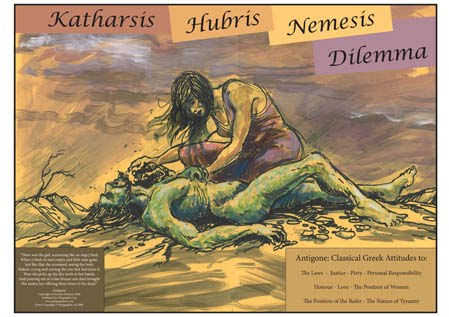
Civil disobedience is when the citizen(s) of a society partake civil acts of disagreement in order to try to solve the problem at hand. with the government In Antigone, a play about civil disobedience, Antigone must make a difficult choice on whether or not she will disobey the King, Creon, in order to release her brother, Polyneices, from eternal suffering on Earth. After
deciding to disobey the King, Antigone is caught and forced to live out her days inside of a cave with only a basket of food and water. Although it seems as though Antigone's act of civil disobedience has brought her own demise, it has actually done the opposite; if she dies in the cave, she will be with her brother and family in the afterlife, while the King stays to suffer the rest of his days alone. In this instance, because civil disobedience was used correctly, the outcome favored the cause. When civil disobedience is used for the greater good of the citizens instead of the governmental authorities, it can be a very effective way of improving the lives of the people. However, if civil disobedience is used to corrupt a government, the outcome will end in the destruction of the initiators of the act and make the government stronger.
Rosa Parks

Rosa Parks was a civil rights activist that, much like Antigonê, stood up for what she believed in and committed an act of civil disobedience. Much like Antigonê did, Mrs. Parks disobeyed her authorities in order to ensure that her life would change for the better. In Antigonê, Antigonê talks to her sister about burying Polyneicês: “They say that Creon has sworn no one shall bury him [Polyneicês]. [...] Ismenê, I am going to bury him[...]” (WordPress). Antigonê knows that Creon has forbidden anyone from burying Polyneicês body, but she decides to commit an act of civil disobedience for the greater good. This ends up working in her favor. In similar, on a Montgomery, Alabama bus, Rosa Parks refused “[...] to surrender her seat to a white male passenger on a Montgomery, Alabama bus, December 1, 1955, [which] triggered a wave of protest December 5, 1955 that reverberated throughout the United States. Her quiet courageous act changed America, its view of black people and redirected the course of history” (rosaparks.org). Although it was the law, Mrs. Parks believed differently and chose to civilly disobey for what she believed in. Because of her actions, Rosa Parks kick-started the modern civil rights movement that ended up removing segregation from America. In both instances, with Mrs. Parks and Antigonê, their acts of civil disobedience helped to solve the problems that she was dealing with.


Howard Zinn

Howard Zinn was a Civil Rights Activist and an Anti-War Activists. He was most known for his work on resisting the Vietnam war. On one of his trips to spread the anti-war movement, Mr. Zinn stated “After my trip to Japan I continued to speak against the war all over the country: teach-ins, rallies, and debates. I was becoming frustrated that no major political figure, no leading periodical, no published book, however critical of the war, dared to say what was so clear to me—that the United States must simply get out of Vietnam as quickly as possible [...]” (howardzinn.org). Much like in Antigonê, Mr. Zinn
resisted his government’s thoughts. In Antigonê, Creon states “Polyneicês, I say, is to have no burial” (WordPress). Although Creon commands this, Antigonê refuses to obey and tries everything to bury Polyneicês. Howard Zinn also did thisby refusing to believe that the war couldn’t be stopped. He constantly fought for the war to be over by using civil disobedience.